It's Brighter Than It Looks, TEDxHawkesbury

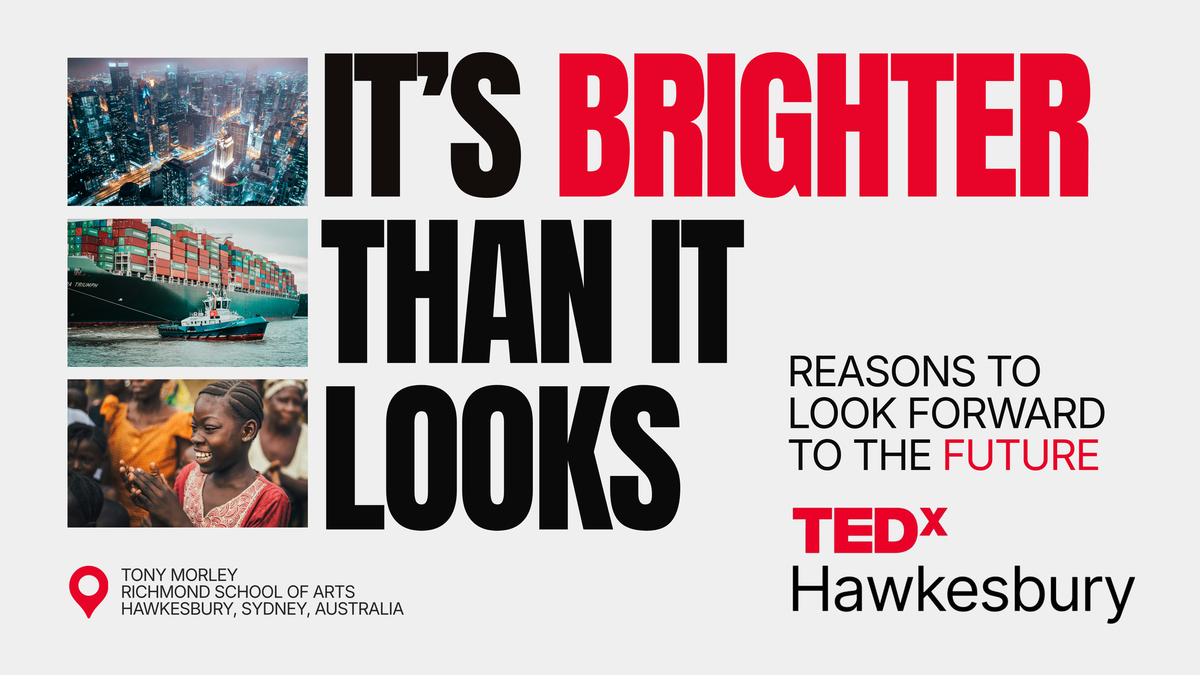
Tony Morley, April 18th, 2026

“War in Europe and the Middle East, and political unrest in the United States. Hunger, poverty, violence. You’d be forgiven, exposed as we are to the narrative of modern media, for believing that the golden age of humanity lies behind us. That the present is terrible, and the future doubly so. The good news is that it’s brighter than it looks. Both the present and the future.” — It's Brighter Than It Looks
The Up Wing, Presenting TEDxHawkesbury
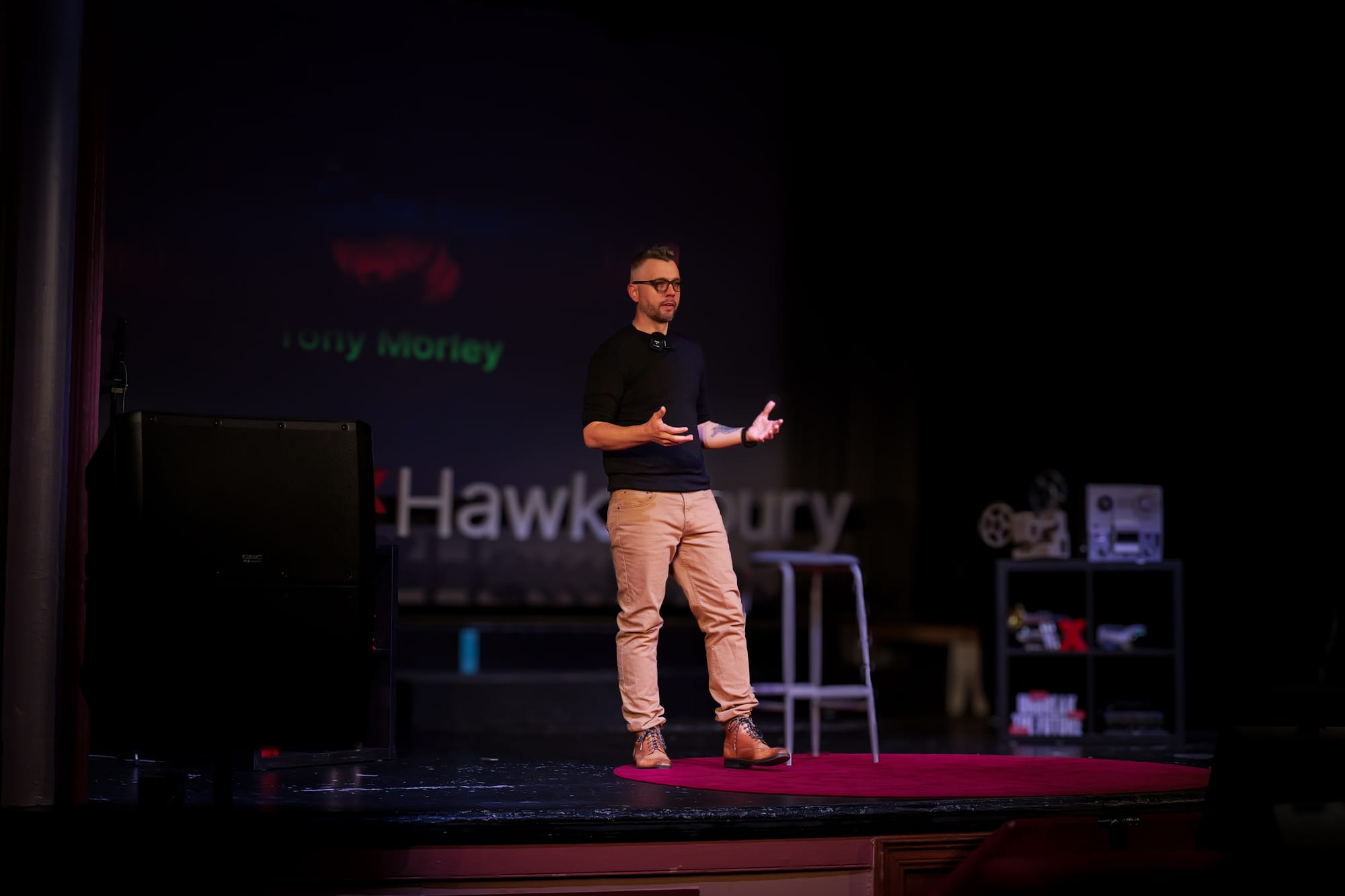
This weekend I had the privilege of presenting “It's Brighter Than It Looks: Reasons to look forward to the Future” for TEDxHawkesbury, Sydney, Australia.
A tremendous thank you to those who supported the talk and helped make it possible by supporting The Up Wing.
“War in Europe and the Middle East, and political unrest in the United States. Hunger, poverty, violence. You’d be forgiven, exposed as we are to the narrative of modern media, for believing that the golden age of humanity lies behind us. That the present is terrible, and the future doubly so. The good news is that it’s brighter than it looks. Both the present and the future.
The last century has seen the greatest uplift in objective human living standards in the roughly 200,000-year history of our species, and while progress for you may look different from progress for a villager in Bangladesh, I would argue that we can agree on some universal, objective measures of progress.
Transcending cultures and nations, we can broadly agree that health is better than disease. Prosperity is better than poverty. Enough to eat is better than hunger. Safety and peace are better than war. Raising healthy children into adulthood is better than burying them. Freedom is better than living under authoritarianism, and happiness is better than misery.
To these metrics and more, we can speak with some confidence on how global living standards have trended over the preceding century. The average global citizen living a century ago, whether born in a rich country —think the United States, Australia, or the United Kingdom —or in a poor country — think China, India, or Bangladesh—spent the entirety of their life in a world with considerably lower relative living standards.
Much, however, has changed between the close of 1926 and the beginning of 2026. Starting with what matters most, life expectancy. Living standards, after all, don’t matter much if you’re not alive and around to enjoy them. A century ago, average global life expectancy was a little over 40 years; by contrast, today it’s more than 73 years. Granted, life expectancy was higher then and remains higher now in rich countries than in poor countries; every country, without exception, has seen its life expectancy climb dramatically, and the gap between rich and poor has narrowed. Where Bangladesh had a life expectancy of just 24 years in 1926, it has climbed to 76 years today. It’s much the same story for every low- and middle-income country: where a century ago only seven countries had a life expectancy over 60 years, today just six fall below 60 years.
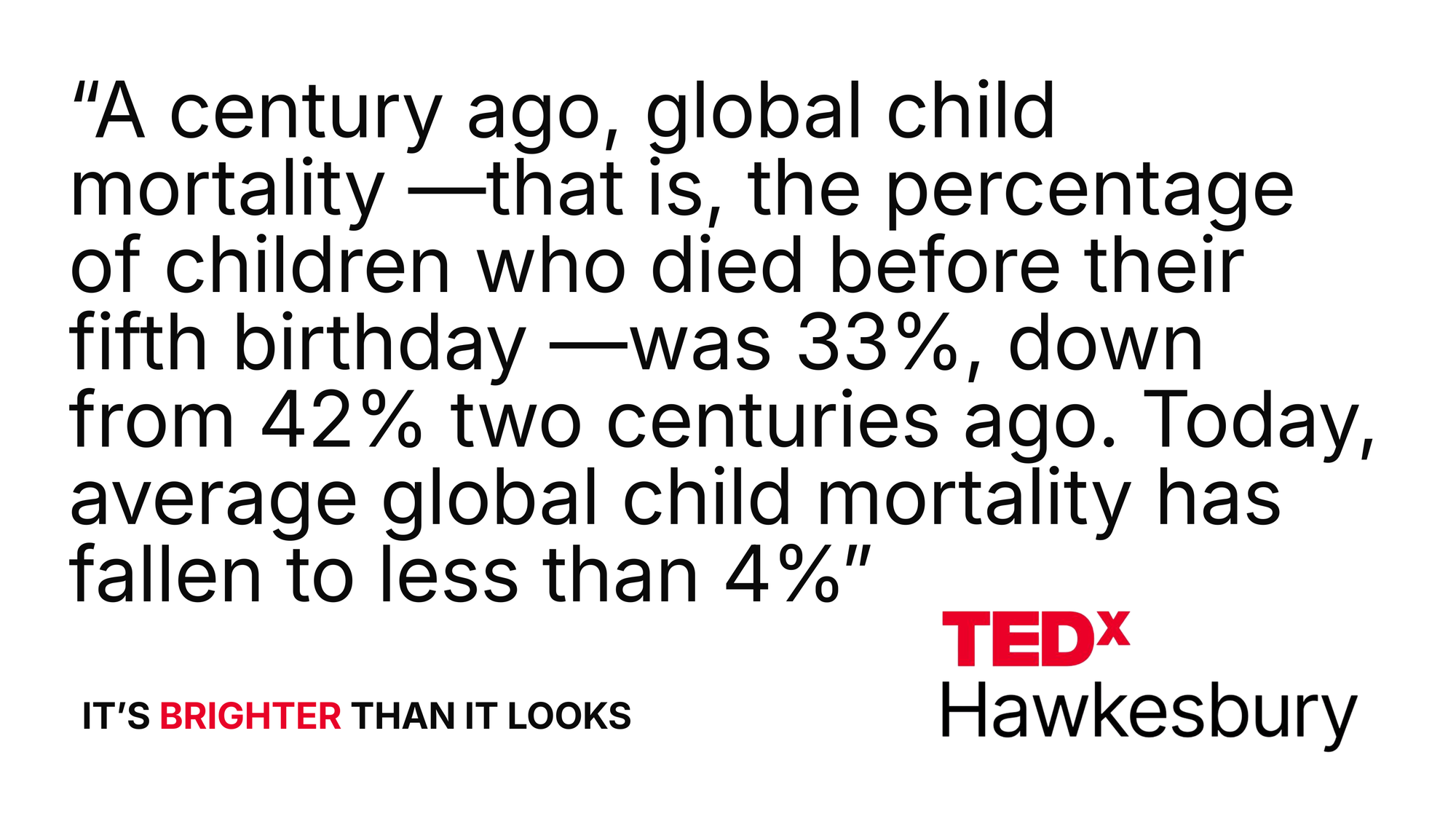
Life expectancy has been pulled down historically by extremely high child mortality: “The world before the modern era was” as put by Bill Bryson, “overwhelmingly a place of tiny coffins.” A century ago, global child mortality —that is, the percentage of children who died before their fifth birthday —was 33%, down from 42% two centuries ago. Today, average global child mortality has fallen to less than 4%, and in the richest countries it’s a fraction of a per cent. Today, a child born in Ethiopia has, on average, a higher chance of seeing their fifth birthday than one born in Sweden in 1926.
Where two centuries ago most parents would expect to bury at least one child, today it’s mercifully uncommon. I myself remember carrying my limp and barely conscious baby into the emergency room, whose life was saved by high-performance antibiotics that weren't available even half a century ago.
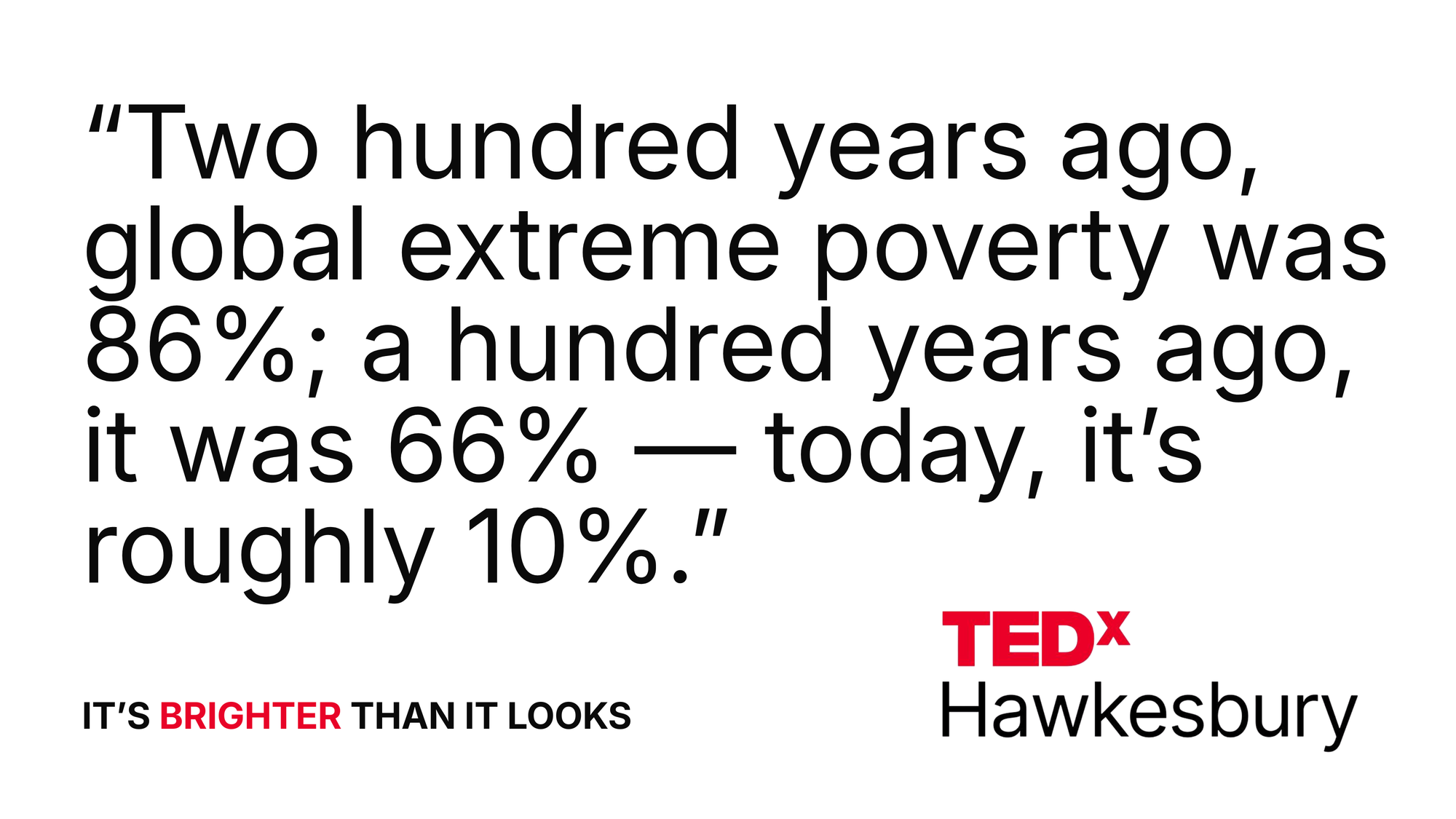
That said, a long and healthy life is still a life of painful struggle, if it’s a life spent in extreme poverty. Nearly the entirety of human history has been spent in extreme poverty; however, in just the last two centuries, humanity has made incredible progress. Two hundred years ago, global extreme poverty was 86%; a hundred years ago, it was 66% — today, it’s roughly 10%.
Leaving aside the century scale for a moment, and looking at just the last 25 years, 153,000 people, on average, have climbed out of extreme poverty each and every day for the last 9,000 consecutive days. A century of strong economic growth, powered by international trade, freedom, science, technology, and the exchange of ideas, has not only reduced poverty but has simultaneously increased personal incomes and material standards of living. Those extra dollars, combined with the falling costs of goods and materials, have increased the average global citizen’s purchasing power.
These few areas of progress we have highlighted are but the smallest sample of ways in which our living standards have skyrocketed in the last century. We must, by necessity, glance over the astonishing fall in the cost of global communications, technology, air travel, food, and a hundred thousand other goods and services. We skip over entirely the incredible decline in maternal mortality, the astounding increase in global literacy and education, and the hundreds of millions of lives saved this century by vaccination, antibiotics, Oral Rehydration Therapy, and improved nutrition. The last century has seen the rise of democracy and freedom, and the slow decline of autocratic rule. Our grandparents and parents have lived through the end, at least to date, of wars between great powers. They have seen humanity, particularly in the West, make bold progress in the rejection of slavery, segregation and racism, and embrace equality, tolerance, and freedom of self-expression. Our homes are warmer in the winter, cooler in the summer and filled with an array of technology and appliances that make life easier, more comfortable and more enjoyable. For the vast majority of metrics, in the vast majority of places, and for the vast majority of people, life today is better for the average global citizen than at any time in human history.
And yet, despite the progress that abounds around us, the vast majority of us feel the world isn’t that great, terrible even, and certainly not getting better for the average global citizen; a sentiment that’s anything but novel. To quote Thomas Babington in 1830, “On what principle is it that with nothing but improvement behind us, we are to expect nothing but deterioration before us?”
Today, we live in a world awash in bad news. Our televisions, computers and phones have become hyper saturated with “if it bleeds it leads” media coverage. Always-on connectivity, combined with the human negativity bias, has left the majority of us feeling that the world we live in today is pretty awful, and perhaps even that the past was better. Bombarded as we are, it’s not unreasonable that many of us have a negative view of the world we live in, and an equally negative view of the future.
Our resulting worldview ends up being significantly more pessimistic than the evidence, on average, supports. Now, that’s not to say that terrible things aren’t happening, aren’t going to happen, or that your individual prospects are inevitably destined for smooth sailing — but rather that on average, the world has been improving in most places, in most ways, for most people.
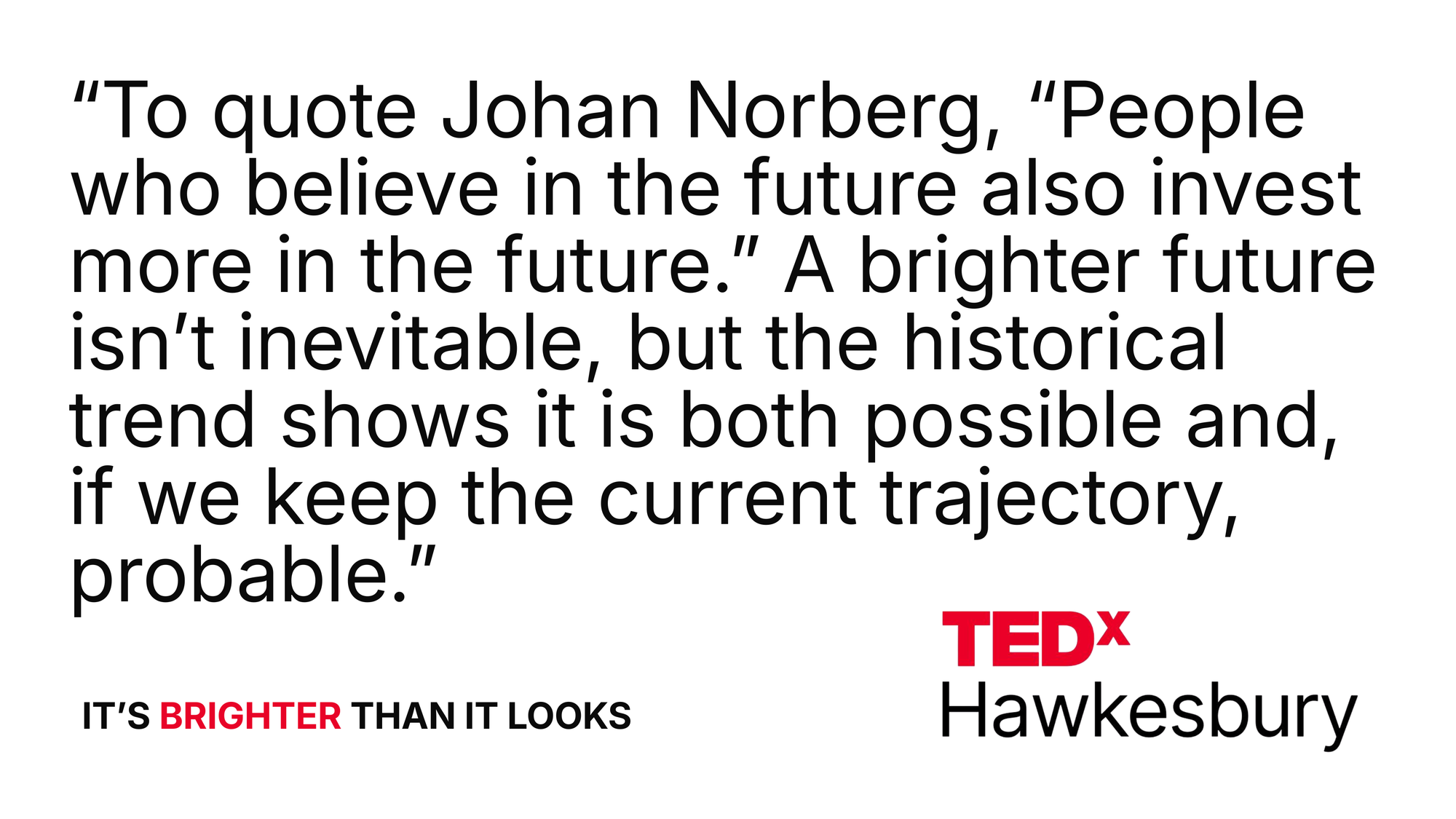
A child born today, whether in Australia or Africa, can expect to live a longer, healthier, more educated and more prosperous life than their equivalent ancestor of a generation before, or a generation before that. That said, progress forward isn’t progress completed, and building a better future will require believing a better future is possible. To quote Johan Norberg, “People who believe in the future also invest more in the future."
A brighter future isn’t inevitable, but the historical trend shows it is both possible, and if we keep the current trajectory, probable.”
TEDxHawkesbury
Date: Saturday 18 April 2026
Sydney Australia
It's Brighter Than It Looks
Reasons to look forward to the future
If you'd like to support the talk, consider dropping the X post a like or repost, or subscribing to The Up Wing.
Hey team, Tony here. Can you help support The Up Wing mission? 80% of our readers are currently free subscribers; please consider supporting our mission and newsletter here: Support The Up Wing